


Durable Van Seat Covers: What Makes Them Last in Work Use
Last Updated: November 27, 2026
Quick Summary
Durable van seat covers rely on abrasion and tear resistance, a waterproof backing that stops spills reaching the foam, a tailored fit that eliminates friction, and reinforced stitching at stress points. A tailored cover stays put, so it absorbs wear instead of rubbing it into the original upholstery.
- Abrasion resistance is measured by rubbing fabric under load until it fails, and the cycle count predicts real-world life.
- The seam is usually the first failure point on a work cover, not the fabric itself.
- Waterproof covers need a sealed or coated backing, not just a water-repellent surface treatment.
- Shake out dust and grit weekly, especially in dusty trades, and wipe spills before they dry.
- Our front sets are £99.95, and a seat cover and rubber floor mat bundle is £149.95.
Table of Contents
- What Makes Van Seat Covers Durable for Work
- Why Work Vans Need Seat Protection
- How Seat Covers Protect Original Upholstery
- Heavy Duty Van Seat Covers: Materials That Survive Daily Wear
- Abrasion, Tear and Puncture Resistance: The Tests That Matter
- Waterproof Van Seat Covers and Moisture Protection
- Dirt, Stains and Job-Site Grime: Keeping the Cab Clean
- Tailored Van Seat Covers: Fit, Installation and Safety
- Van Seat Cover Cleaning and Maintenance for Long Service
- Choosing by Trade: Plumbers, Electricians, Couriers and Camper Conversions
- Total Cost of Ownership: Price, Repairability and Resale Value
- Find Your Fit Before You Buy
- Frequently Asked Questions
What Makes Van Seat Covers Durable for Work
Durability in van seat covers for work comes down to four things: the fabric's abrasion and tear resistance, a waterproof backing that stops spills reaching the foam, a tailored fit that eliminates friction, and reinforced stitching at the stress points. Get any one of those wrong and the cover fails long before the van does. A commercial vehicle interior takes punishment that a family car never sees.
Most cheap covers fail for a reason that has nothing to do with the fabric. They fail because they move.
A universal cover that shifts a few millimetres on every entry and exit rubs against the original upholstery thousands of times a year. The friction wears through the cover and the seat beneath it. A tailored cover, cut to the specific seat frame, stays put, so the protective layer absorbs the wear instead of transmitting it.
Below, we break down the materials, the tests and the trade-offs that actually determine how long a set lasts, plus how to pick the right cover for your van and your line of work.
Why Work Vans Need Seat Protection
A work van's driver's seat is a wear surface, not a piece of furniture. A tradesperson climbing in and out with dusty boots, a courier sliding across the seat at every stop, or a plumber resting a toolbox on the passenger side subjects the upholstery to daily wear that factory fabric was never specified to survive.
Once the original upholstery is stained, torn or compressed, you are looking at a reupholstery bill or a hit at resale. A protective layer fitted from new preserves the seat underneath, and that matters when the van goes back to the lease company or onto the forecourt.
How Seat Covers Protect Original Upholstery
Seat covers protect original upholstery by acting as a sacrificial barrier: they absorb abrasion, block liquids and trap grit before it reaches the fabric underneath. The mechanism is straightforward. Every scuff, spill and friction rub lands on the cover instead of the seat, and the cover can be removed, cleaned or replaced at a fraction of the cost of reupholstery.
The key word is sacrificial. A cover that grips the seat and stays in place takes the punishment in a controlled way. A loose cover moves, and movement is what grinds dirt into the original fabric like sandpaper.
Heavy Duty Van Seat Covers: Materials That Survive Daily Wear
Heavy duty van seat covers are defined less by a marketing label and more by measurable fabric properties: weight per square metre, abrasion cycles to failure, tear strength and hydrostatic head, which is how much water pressure a fabric resists before it leaks. Ask for those figures and you can compare covers honestly. Accept a "heavy duty" badge with no numbers behind it and you are buying on trust alone.
The material choice matters more than anything else on this list. Here is how the main options compare.
| Material | Abrasion & Tear | Water Resistance | Breathability | Best For |
|---|---|---|---|---|
| Canvas / duck weave | High | Low unless coated | Moderate | Dry trades, dusty sites |
| Neoprene | Moderate | High | Low | Wet trades, spill-heavy work |
| Vinyl | High | High | Very low | Heavy grime, easy wipe-down |
| Coated woven fabric | High | High | Moderate | All-round commercial use |
Canvas, Duck Weave and Heavy-Duty Woven Fabrics
Canvas and duck weave are tightly woven cotton fabrics, and their durability comes from thread density and weight. A heavier weave resists abrasion and tearing well and breathes reasonably, which keeps the seat comfortable across long working days. The weakness is moisture: uncoated canvas soaks up spills and takes time to dry, so it suits dry trades better than wet ones.
Neoprene, Vinyl and Waterproof Fabric Compared
Neoprene is a synthetic rubber that shrugs off water and spills, making it a strong pick for wet trades. Vinyl is the easiest to wipe clean and handles job-site grime well, though it traps heat and offers little breathability. Waterproof coated fabrics aim for the middle ground: a woven face for comfort with a backing that keeps moisture out. For most commercial use, that balance wins.
Abrasion, Tear and Puncture Resistance: The Tests That Matter
Abrasion resistance is measured by rubbing fabric under a known load until it fails, and the cycle count is the number that predicts real-world life. Tear resistance measures how much force is needed to propagate a rip once it starts (bsigroup.com). Puncture resistance matters on vans because tools, buckles and sharp edges get rested on seats constantly.
What most buyers miss is that fabric thickness alone tells you very little. A thick, loosely woven material can tear more easily than a thinner, tightly woven one with reinforced seams. Look for documented test results rather than a hand-feel judgement.
The problem is that most listings give you a badge, not a number. To compare covers on evidence, ask suppliers for four figures and read them together rather than in isolation.
- Abrasion cycles. The standard method rubs the fabric against a specified abrasive under a set load and records the cycles to failure. A higher cycle count means the face fabric resists scuffing for longer. Ask which load and abrasive were used, because a cycle count quoted without its test conditions cannot be compared with another supplier's figure.
- Tear strength. This is the force needed to extend a cut or nick once it has started. It matters most at the seams and around fixing points, where a small snag can run. A tightly woven fabric with a modest tear strength often outperforms a heavier, looser weave.
- Seam strength. The seam is usually the first failure point on a work cover, not the fabric. Ask whether seams are double-stitched, bound or taped, and whether the maker quotes a seam strength separately from the fabric strength. A strong fabric on a single-stitched seam still splits.
- Surface abrasion versus edge abrasion. A cover can resist rubbing across its face while fraying at a cut edge or a fixing hole. Check that edges are bound or heat-sealed and that fixing points are reinforced rather than punched straight through the weave.
Watch out: a high abrasion cycle count tells you nothing about tear or seam performance, so a cover marketed on abrasion alone may still fail at the stitching within months.
Puncture resistance is harder to quote because there is no single consumer-facing figure most suppliers publish. In practice, judge it by construction: a tight weave, a coated backing and reinforced panels at the seat base and bolsters resist sharp edges better than a loose pile or an open weave. If you routinely rest tools or carry buckles and clips on the seat, prioritise a coated woven fabric over an uncoated canvas.
A common pattern among buyers who get this wrong is to compare one headline number across products. Two covers quoting abrasion cycles from different test loads are not comparable, and a tear strength quoted in newtons means little without knowing where on the fabric it was measured. Treat any single figure as a starting filter, then confirm seam construction, edge finishing and fixing reinforcement before you buy.
Waterproof Van Seat Covers and Moisture Protection
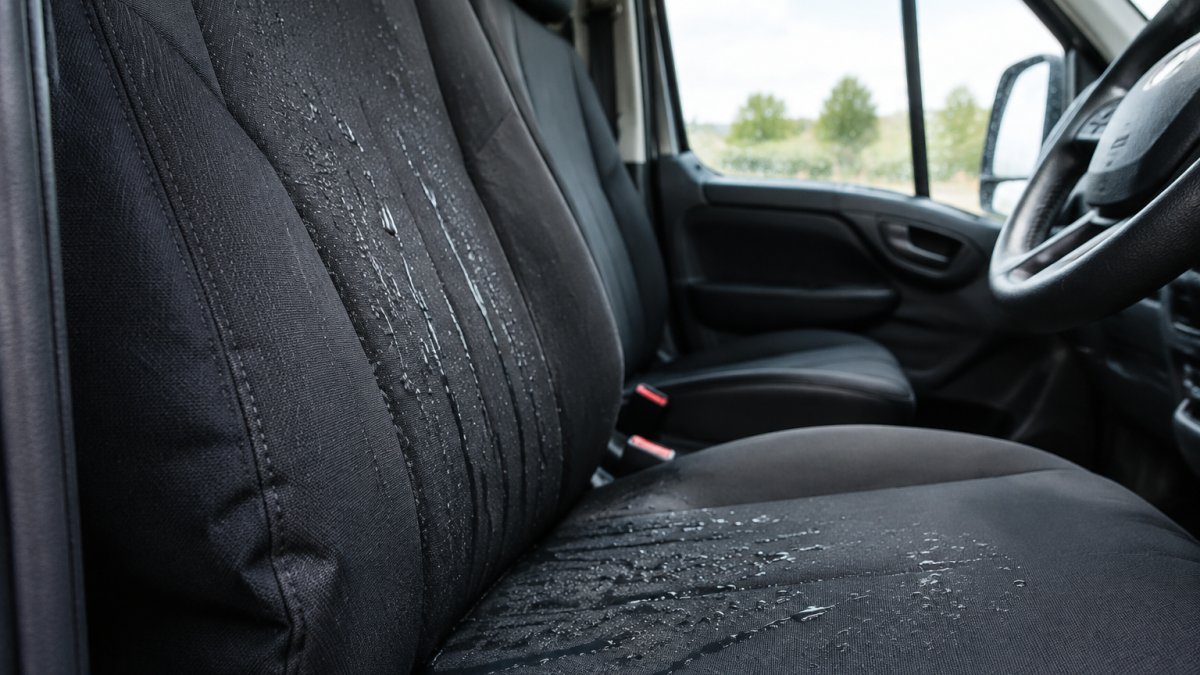
Waterproof van seat covers are designed to stop moisture reaching the foam beneath. Once water soaks into seat foam it dries slowly, smells, and can corrode the seat frame over time. Wet workwear, spilled drinks and damp tools all feed that problem.
A genuinely waterproof cover has a sealed or coated backing, not just a water-repellent surface treatment. Water-repellent fabric beads liquid for a while; waterproof fabric holds it out under pressure. Watch out: a cover described only as "water resistant" will eventually let liquid through at a seam, so check that the seams are sealed or taped.
Dirt, Stains and Job-Site Grime: Keeping the Cab Clean
Job-site grime is abrasive, and that is why it wears upholstery so quickly. Brick dust, cement powder, plaster and road grit work into fabric fibres and act like a grinding paste every time someone sits down. A wipe-clean or machine-washable cover lets you remove that grit instead of grinding it in.
Tailored Van Seat Covers: Fit, Installation and Safety
Tailored van seat covers are cut to a specific vehicle's seat pattern, which is what separates them from universal covers. The fit does two jobs: it stops the movement that causes friction wear, and it keeps the cover clear of the seat's mechanical and safety functions. A properly tailored cover allows access to seat controls, armrests and fold-down trays.
On safety, confirm with the product listing for your vehicle that the cover does not interfere with seat functions before fitting.
Our tailored covers are hand-cut and sewn to O.E.M standards for specific makes and models, with a Grip X easy-fit system that holds the cover in position. If you are unsure whether covers interfere with your seat's functions, our FAQs answer the practical fit and function questions directly.
Van Seat Cover Cleaning and Maintenance for Long Service
Van seat cover cleaning and maintenance is simple, and it is the difference between a cover that lasts years and one that fails in months. Shake out loose grit weekly, wipe spills promptly, and wash removable covers according to the maker's instructions. Avoid harsh solvents that break down waterproof coatings.
- Shake out dust and grit weekly, especially in dusty trades
- Wipe spills before they dry into the weave
- Wash machine washable covers on a cool cycle and air dry
- Check seams and fixings monthly for early signs of wear
- Refit carefully so the cover sits tight against the seat
Choosing by Trade: Plumbers, Electricians, Couriers and Camper Conversions
Trade-specific selection beats a one-size recommendation because the failure mode changes with the job. The right cover for a courier is not the right cover for a plumber, even if both drive the same van model.
Builders and site workers. The dominant exposure is abrasive dust and grit, plus tools and fixings rested on the seat. Prioritise a tightly woven, coated fabric with reinforced seat-base panels and bound edges.
Plumbers and heating engineers. Wet workwear, damp tools and the occasional spill are the main threats, with sharp edges from pipe cutters and spanners close behind. A waterproof coated fabric with a sealed or taped backing and good puncture resistance is the priority.
Electricians. The mix is dust, cable offcuts and the risk of snagging on fixings and trunking. A tight weave with strong tear and seam strength resists snags better than a loose pile.
Couriers and delivery drivers. The defining exposure is frequency: dozens of entry and exit movements a day, often sliding across the seat.
Gardeners and landscapers. Mud, green waste, damp and grit combine, and the seat often carries plant debris.
Mechanics and mobile technicians. Oils, greases and solvents are the main threat, alongside sharp tools. Vinyl and coated fabrics wipe clean and resist oil penetration, but check that the coating is resistant to the solvents you actually use, because some coatings soften with repeated contact.
Camper conversions. The priority shifts to appearance and comfort alongside daily durability. A tailored cover in a woven or coated fabric preserves the look while handling family use, and a fit that clears the seat's fold-down trays and armrests matters as much as the fabric.
For Transit Custom owners, our Ford Transit Custom seat covers are cut to the model's seat pattern, including the fold-down tray and cupholder layout.
Best for: wet trades and high-mileage couriers. Skip if: you rarely carry passengers or wet kit and want a simple budget cover.
Total Cost of Ownership: Price, Repairability and Resale Value
Total cost of ownership is where cheap covers lose. A low-cost universal cover that bunches and tears within months gets replaced repeatedly, and all the while the friction underneath is wearing the original upholstery. A tailored cover bought once, cleaned and refitted, protects resale value far more effectively.
Our front sets are £99.95, and a seat cover and rubber floor mat bundle is £149.95. For fleets buying ten or more, our trade and fleet account covers bulk pricing and credit terms.
Find Your Fit Before You Buy
Fit is the single biggest factor in durability, so confirm your exact model and seat layout before ordering. Check whether your van has a single or double passenger seat and whether it has a fold-down tray.
Browse the full shop all seat covers range to match a set to your van, or start with our waterproof seat covers if moisture protection is your priority.
Durability is not a marketing claim, it is a set of measurable properties: abrasion cycles, tear strength, a sealed waterproof backing, and a fit that keeps the cover still. Roadtrim engineers tailored covers to O.E.M standards, hand-cut and sewn for specific vans, with a Grip X easy-fit system and model-fit alerts so you order the right set first time. Get started with Roadtrim and protect your van's interior for years of work.
Frequently Asked Questions
What material is best for hard-wearing van seat covers?
It depends on the abuse the seats take. Heavy-duty woven fabrics such as canvas and duck weave resist abrasion and scuffing from tools and boots, while waterproof materials handle spills and wet clothing. Neoprene and vinyl are easier to wipe clean but can feel less breathable over long working days. The strongest options combine a tough outer face with reinforced seams, and are cut to fit a specific van model rather than a generic shape.
Are waterproof van seat covers durable enough for daily work?
Waterproof van seat covers are durable when the waterproof layer is part of the fabric rather than a coating that rubs off. Check that the material is tested for abrasion and that seams are stitched to resist tearing. A waterproof cover also stops moisture from spills, wet tools and damp workwear reaching the original upholstery, which is where most long-term damage and odour starts.
How should van seat covers fit to prevent wear and slipping?
A close, tailored fit is the single biggest factor in preventing wear and slipping. Loose universal covers bunch and rub against the seat, which wears both the cover and the upholstery underneath. A tailored cover follows the contours of the seat, headrest and armrest, and stays put through repeated sliding in and out.
Do tailored van seat covers last longer than universal covers?
In most cases, yes. Tailored van seat covers are cut and sewn for a specific model, so there is less slack fabric to catch, crease and tear. Universal covers rely on straps and elastic to hold a loose shape, which is where bunching and premature wear usually begin. A tailored cover made from a heavy-duty material and tested to O.E.M standards is the more reliable long-term investment for a working van.
How do you clean and maintain work van seat covers?
Shake out loose dust and grit regularly, then wipe the covers with a damp cloth and a mild detergent. For deeper cleaning, check whether the covers are machine-washable before removing them, and follow the manufacturer's temperature guidance. Avoid harsh solvents that can break down waterproof coatings. Prompt cleaning of spills and mud prevents stains setting and keeps the fabric's abrasion resistance intact.
